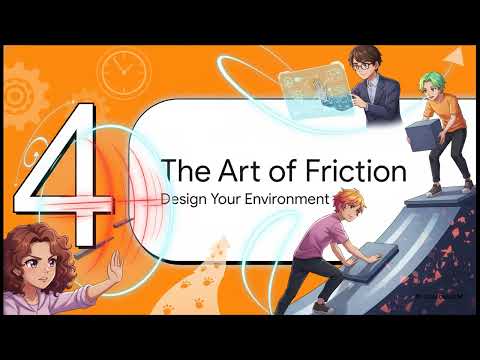
Hacking Your Habits: crack the code behind every habit
Habits are a code running on autopilot, and any code can be cracked.

The big ideas
What the book says, and what it means for how you move, rest and live.
Cue, routine, reward, powered by craving. The 3pm slump leads to a biscuit, then a sugar rush.
Keep the cue and the reward, swap the routine: stressed at work, take a 5-minute walk instead of a cookie.
One habit, like regular exercise, pulls others along: better food, better sleep, less stress.
It tires with overuse, but you can train it.
'When I feel too tired for the gym, I'll put on my workout clothes.'
Try it for the next 3 days
Find your weak moment, like right after work. Write one line: "When ___ happens, I will ___." Follow it for the next 3 days.
Read the full summary
Why bad habits are easy and good ones are hard
You want solid habits around health, nutrition and fitness, but wanting it isn't enough. You need a blueprint. We've all started a workout plan full of energy, only to be back where we started a few weeks later. Why is it so easy to fall into bad habits and so hard to make good ones stick? The answer is wired into our brains. Habits aren't really about willpower. They're a neurological code running on autopilot, and any code can be cracked.
The plan: break down the code behind every habit, learn the golden rule for changing them, find your keystone habit, and reframe willpower as a skill you can build.
The habit loop
Deep in your brain is the basal ganglia, your brain's efficiency expert. Its job is to turn a series of actions into an automatic routine to save energy, through the habit loop.
- Cue: the trigger. The 3pm energy slump at work, the tiredness, the glance at the clock.
- Routine: the action. Walking to the pantry for a biscuit, or ordering a sugary chai.
- Reward: the sugar rush and burst of satisfaction, which tells your brain, "That felt good, remember it."
This loop runs in the background all day, from how you answer your phone to how you handle stress. And one more piece makes it spin: craving. Once your brain links the cue to the reward, it starts to anticipate the reward. That anticipation is the craving that powers the loop and makes it so hard to resist.
The golden rule of habit change
You can't just delete a habit. Instead, keep the cue, keep the reward, and consciously swap in a new routine. You hijack the existing loop. The cue: you feel stressed at work. The reward you crave: relief and a little break. Instead of reaching for a cookie, take a quick five-minute walk. You still get the relief, through a healthy routine.
Keystone habits
Some habits are more powerful than others. Keystone habits are small wins that set off a chain reaction, pulling other good habits along. For many of us, a consistent fitness routine is the ultimate keystone habit. Once you exercise regularly, you naturally want to eat better, you sleep more soundly and you're more productive, without much extra effort. One habit, like a morning workout, knocks over a row of dominoes: better food choices, better sleep, less stress.
It works for organisations too. When Paul O'Neill became CEO of Alcoa, he didn't talk about profits. He focused on one thing: worker safety. Changing the routines around that one keystone habit changed everything, and the company's market value grew by billions of dollars under his leadership.
Willpower is a muscle
Willpower isn't a fixed trait; it's a skill, and it behaves like a muscle. Use it too much and it gets tired. In one famous study, people who had to eat radishes instead of fresh-baked cookies gave up faster on a hard puzzle afterwards. But like any muscle, it can be trained.
The best way to train it is to plan for the moment it will fail. First, identify your inflection point, the moment of weakness, like right after work when you feel too tired for the gym. Then write a simple plan: "When I feel too tired to go to the gym, I will immediately put on my workout clothes." That makes the next step automatic and saves your willpower for when you really need it.
Your blueprint
- Understand the cue, routine, reward loop.
- Use the golden rule to swap the routine.
- Find your keystone habit.
- Train your willpower by planning for weak moments.
So, what is the one keystone habit you'll commit to building, starting today?
Put it into practice
Habits stick when you do them with others. Start one today.
Fittest Start
Join the ExperienceA summary and interpretation by Fittest Club, not affiliated with the author or publisher. General wellness information only, not medical advice.
More from Habilearn
One book, one video, one habit.